


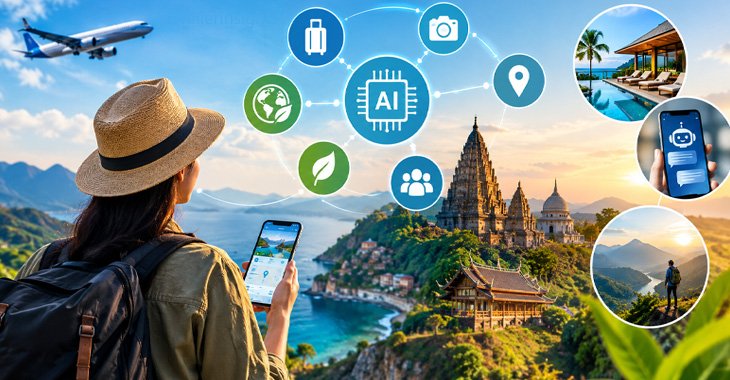
Every year on September 27, World Tourism Day draws attention to the social, cultural and economic importance of tourism and its role in connecting people, communities and countries.
In 2026, the global tourism industry is observing the occasion at a particularly significant moment, as technology and artificial intelligence (AI) are rapidly changing how people discover destinations, plan journeys, book accommodation, experience attractions and interact with travel businesses.
The theme for World Tourism Day 2026 is “Digital Agenda and Artificial Intelligence to Redesign Tourism.”
The theme highlights the growing influence of digital transformation and AI across the tourism value chain, from travel planning and personalised recommendations to operational efficiency, destination management and sustainability.
Tourism has always evolved alongside changes in transportation, communication and consumer behaviour. The digital revolution has accelerated that evolution.
Today, travellers can research destinations, compare prices, make reservations, access digital maps, translate languages and share experiences from virtually anywhere.
AI is taking this transformation further by enabling tourism businesses and destinations to analyse enormous amounts of information and deliver increasingly personalised services.
Tourism Enters a New Digital Era
Tourism is one of the world’s major economic sectors, supporting employment and livelihoods across countries and communities. The United Nations notes that tourism employs approximately one in every ten people globally and provides livelihoods to hundreds of millions more.
It also contributes to several Sustainable Development Goals, particularly those related to economic growth, responsible consumption and the sustainable use of marine resources.
The importance of tourism extends beyond economic activity. Travel creates opportunities for cultural exchange, supports local businesses and allows visitors to experience natural and cultural heritage.
At the same time, tourism destinations face challenges related to overcrowding, environmental pressures, resource consumption and unequal distribution of tourism benefits.
Digital technologies can play an important role in addressing some of these challenges.
Artificial intelligence, in particular, is changing the way tourism stakeholders understand travellers and manage their operations. Instead of relying solely on traditional surveys and historical information, businesses can use data-driven technologies to identify travel patterns, anticipate demand and respond more quickly to changing customer expectations.
AI Is Changing How People Plan Travel
One of the most visible applications of AI is in travel planning.
Traditionally, planning a holiday could involve searching multiple websites, reading reviews, comparing hotels, checking transportation options and creating an itinerary manually. AI-powered tools can bring many of these activities together by helping travellers organise information according to their individual preferences.
A traveller may seek a destination based on budget, weather, interests, available time, accessibility requirements or preferred activities. AI can analyse these parameters and generate recommendations or itineraries.
This does not necessarily mean that human travel professionals will become irrelevant. Instead, their role can evolve. Travel advisors can spend less time on repetitive information gathering and more time understanding customers, managing complex trips and providing specialised advice.
For tourism companies, this creates an opportunity to combine technological efficiency with human expertise.
Personalisation Becomes a Major Competitive Factor
Travellers increasingly expect experiences that match their individual preferences.
A family travelling with children may require a completely different itinerary from a solo traveller interested in adventure tourism. Similarly, a business traveller may prioritise convenience and connectivity, while a leisure traveller may focus on cultural experiences and local cuisine.
AI can help tourism companies process customer information and identify patterns that enable more personalised recommendations.
Hotels, airlines, travel agencies, online travel platforms and destination-management organisations can potentially use AI to understand customer behaviour and provide relevant recommendations at different stages of the travel journey.
Personalisation can also extend beyond bookings. Digital assistants can help travellers find restaurants, attractions, transportation options and activities during their trip.
The result is a tourism experience that increasingly adapts to the traveller rather than requiring the traveller to navigate a standardised process.
Smarter Operations for Tourism Businesses
The impact of AI is not limited to the customer-facing side of tourism.
Behind the scenes, tourism businesses deal with complex operational challenges. Hotels need to manage rooms, staffing, energy consumption and customer service. Airlines and transportation providers need to manage capacity, schedules and demand. Attractions need to handle visitor flows and resources.
AI can support these functions through forecasting and automation.
Demand forecasting, for example, can help businesses anticipate periods of high or low demand. Hotels can use data analysis to understand booking patterns, while transportation providers can analyse travel trends to support operational planning.
AI can also assist with customer-service functions through chatbots and virtual assistants. These systems can handle routine questions about bookings, check-in times, facilities, cancellation policies and destination information.
For businesses, automation can reduce repetitive workloads while allowing employees to focus on situations requiring judgement and human interaction.
AI and Sustainable Tourism
Sustainability is another important dimension of the 2026 theme.
Tourism can generate significant economic and social benefits, but destinations also need to manage environmental pressures. The United Nations highlights tourism’s connection with sustainable development and notes the sector’s importance to biodiversity conservation in many areas.
Digital technologies can contribute to more efficient resource management.
Hotels, for instance, can use smart systems to monitor energy and water consumption. Destination authorities can analyse visitor data to understand congestion and potentially manage tourist flows. Transportation systems can use digital information to improve efficiency.
AI can also help tourism organisations identify patterns in visitor behaviour and develop strategies to distribute tourism activity across different locations and seasons.
This could be particularly relevant for destinations experiencing overcrowding. Instead of concentrating visitors around a small number of famous attractions, digital platforms could introduce travellers to lesser-known locations and local experiences.
However, technology alone cannot guarantee sustainable tourism. It needs to be combined with appropriate policies, infrastructure, environmental standards and community participation.
The Challenge of Digital Inequality
While AI presents significant opportunities, the digital transformation of tourism also raises important questions.
Not every tourism business has the same access to technology. Large international companies may have substantial financial and technical resources, while small hotels, local guides, family-owned restaurants and community-based tourism operators may have limited access to advanced digital systems.
This creates the possibility of a digital divide within the tourism sector.
The United Nations has emphasised the importance of investing in digital skills and ensuring that technological progress benefits tourism workers, local communities and emerging destinations. Secretary-General António Guterres, in his 2026 World Tourism Day message, also highlighted the need for technology to remain human-centred and inclusive.
For AI-driven tourism to deliver broad benefits, smaller businesses need access to affordable technology, training and digital infrastructure.
Protecting Human Connection in a Technology-Driven Industry
Tourism is fundamentally a human activity.
People travel not only to reach destinations but also to interact with cultures, communities and other people. A local guide sharing the history of a monument, a family-run restaurant introducing visitors to regional cuisine or a craftsperson explaining a traditional technique cannot necessarily be replaced by an algorithm.
AI can provide information, but meaningful experiences often depend on human interaction.
This distinction will become increasingly important as technology becomes more sophisticated. The objective should not simply be to automate every aspect of travel. Instead, technology can be used to remove friction while preserving the human elements that make tourism meaningful.
A digital itinerary can help a traveller organise a trip, but local knowledge can transform that itinerary into a memorable experience.
The Need for Responsible AI
The rapid expansion of AI also creates the need for responsible implementation.
Tourism businesses may handle significant amounts of customer information, including preferences, booking details and behavioural data. Organisations therefore need appropriate approaches to privacy, security, transparency and responsible data use.
AI-generated recommendations should also be monitored for accuracy and potential bias. If algorithms repeatedly direct travellers toward the same destinations, hotels or attractions, lesser-known businesses and emerging destinations could struggle to gain visibility.
The 2026 World Tourism Day message specifically recognises this concern, noting that unchecked AI could concentrate tourists around the same destinations and platforms while leaving other worthwhile destinations behind.
Responsible digital transformation therefore requires more than adopting the latest technology. It requires tourism organisations to consider how technology affects businesses, workers, communities, travellers and destinations.
Opportunities for India
For India, the digital transformation of tourism presents opportunities across a wide range of destinations and tourism categories.
The country’s diverse cultural heritage, pilgrimage destinations, wildlife, beaches, mountains, food traditions and growing urban tourism ecosystem provide a broad base for technology-enabled travel experiences.
AI-powered travel planning can potentially help visitors discover destinations beyond major tourist centres. Digital storytelling can help promote cultural and historical attractions, while multilingual technologies can make information more accessible to international visitors.
Small tourism businesses can also benefit from digital platforms that improve their visibility and connect them with travellers.
The challenge will be ensuring that digital growth reaches smaller tourism operators and local communities rather than remaining concentrated among large platforms and established businesses.
Tourism Jobs Will Evolve
Another important question is the impact of AI on tourism employment.
Tourism is a major source of employment globally, and the United Nations notes that it provides an important entry point into the world of work, particularly for women, young people, migrant workers and rural populations.
AI may automate certain repetitive tasks, but it can also create demand for new skills.
Tourism professionals may increasingly need capabilities in digital marketing, data analysis, AI-assisted customer service, digital content, revenue management and technology-enabled destination management.
This makes education and upskilling essential.
Rather than viewing AI simply through the lens of job replacement, the tourism sector will increasingly need to consider how workers can be equipped to work alongside emerging technologies.
A New Definition of the Travel Experience
World Tourism Day 2026 arrives at a point when the definition of a travel experience is changing.
The journey now begins long before a traveller reaches an airport or hotel. It can start with an AI-powered search, continue through a digital booking platform, involve real-time mobile assistance during the trip and extend into social media sharing after the journey.
Every stage generates information and creates opportunities for businesses to understand travellers better.
Yet the future of tourism will not be determined by technology alone.
The central question is how technology is used.
If AI is used only to maximise transactions, tourism could become increasingly automated and concentrated. If it is used to improve accessibility, support local businesses, manage destinations responsibly, reduce resource consumption and create better experiences, it can contribute to a more inclusive tourism ecosystem.
Looking Ahead
World Tourism Day 2026 provides an opportunity to look beyond the excitement surrounding artificial intelligence and consider the broader transformation taking place across the tourism industry.
The theme “Digital Agenda and Artificial Intelligence to Redesign Tourism” reflects a tourism sector entering a new phase of technological change.
AI can help travellers make informed choices, businesses improve efficiency and destinations manage resources more effectively. At the same time, responsible implementation will require attention to digital inclusion, privacy, workforce development, sustainability and the preservation of human connection.
The future of tourism is therefore unlikely to be simply digital or human. It will increasingly be a combination of both.
Technology can provide speed, scale and intelligence. People provide creativity, empathy, cultural understanding and genuine connection.
As the world celebrates World Tourism Day on September 27, 2026, the industry’s next chapter will depend on how effectively these two dimensions can work together.
The goal is not merely to make travel smarter, but to make tourism more inclusive, sustainable, accessible and meaningful for the people and places that make travel possible.






Leave a Reply